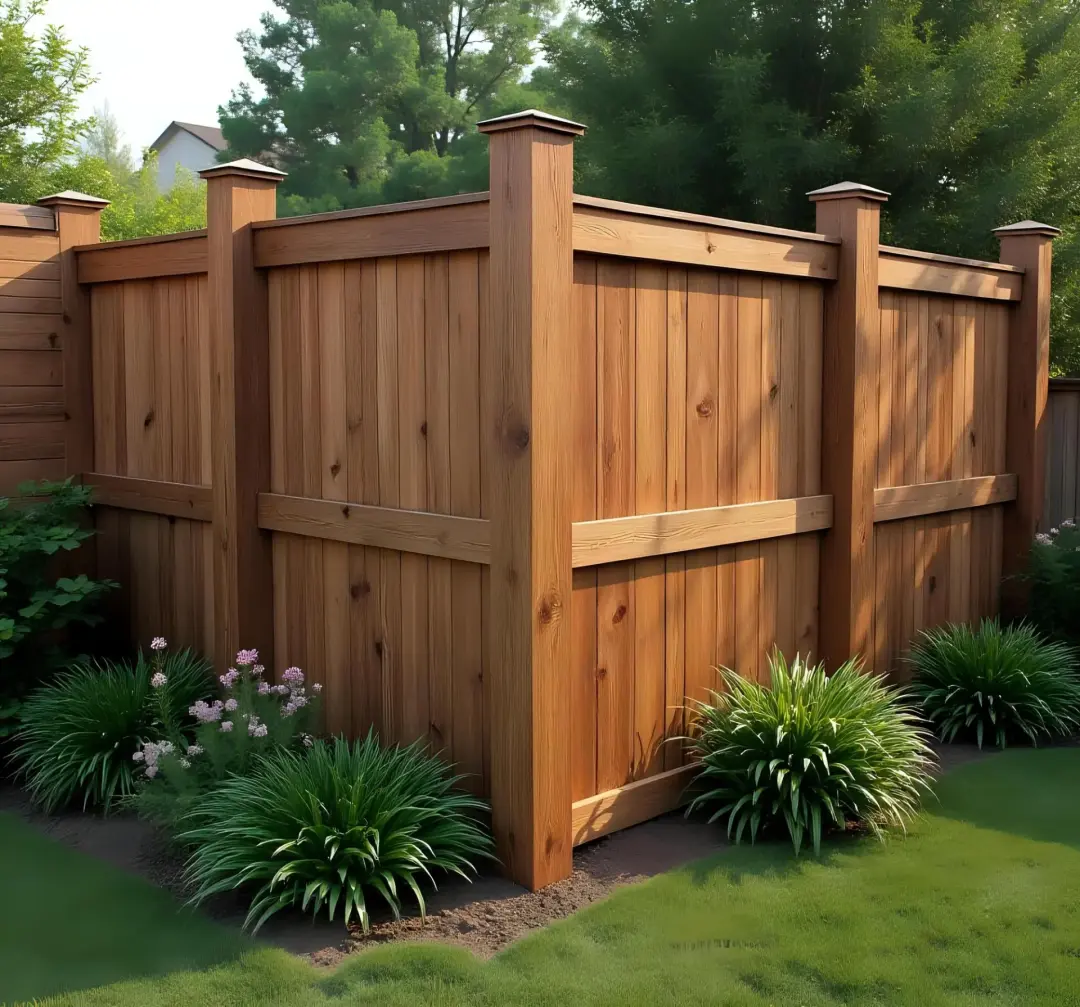
Measure each straight fence run separately, record changes in level and check the exact panel-and-post system you intend to use. Dividing the perimeter by a nominal panel width gives only a rough estimate. Accurate ordering also accounts for posts, gates, corners, fittings and any reduced-width panels needed to complete the layout.
Measuring for Fence Panels: Establish the Line
Identify the intended fence line before measuring. Do not move a boundary simply to make full-width panels fit. Check the relevant property documents and discuss uncertainty with your neighbour before ordering or digging.
GOV.UK explains that most title plans do not show exact boundaries. Scaling a plan's red line is not a substitute for measurements on site or a way to settle a disagreement. For a Blackburn garden with an unclear boundary, resolve its position first: accurate measurements along the wrong line do not make a usable fencing plan.
Sketch and Label Each Straight Run
Use a tape measure, notebook and pencil, with a string line and level where helpful. Draw the garden from above and label straight sections A to B, B to C and so on. Mark gates, walls, trees, drains, restricted access and changes in direction.
Use millimetres throughout. Record whether each length is between existing post faces, between centres or between the outside ends of the proposed fence. These are different measurements. Repeat long measurements and take photographs keyed to the sketch so an installer can identify obstacles a single length cannot describe.
Check the Actual Panel Width
Panels described as “6 ft” are not necessarily interchangeable. Jacksons Fencing lists its standard width as 1,830 mm, while some other systems use 1,800 mm. A 30 mm difference repeated across ten panels adds up to 300 mm before post allowances. That can change the layout significantly.
Use the chosen product's published dimensions rather than a rounded shop label. If you are still comparing designs, read how to choose the right fence panels for your garden before finalising your measurements. Confirm thickness, especially when reusing concrete slots or brackets. Measure existing openings at the top, middle and bottom: leaning posts can prevent a nominally suitable panel from fitting.
Include the Correct Post Allowance
Face-fixed panels and slotted posts need different calculations. In a slotted system, part of the panel enters the post, so adding a full post width to every panel can overestimate the total run.
Jacksons' measurement guide uses a nominal 1,880 mm module for its 1,830 mm panels and specified slotted posts, with separate attention to end and corner arrangements. Do not apply that number to another manufacturer's system.
For a simplified alternative example, five 1,800 mm panels fitted between six 100 mm posts occupy 9,600 mm: 5 × 1,800 + 6 × 100. This assumes no slot overlap or fitting allowance. Real installations require the selected system's connection details, so the example illustrates arithmetic rather than providing an order list.
Record Heights and Sloping Ground
List the desired finished top height and any gravel board separately from panel height. A panel is only part of the complete assembly. Check any permissions needed for the proposed finished height before ordering.
On a slope, record horizontal distance and vertical rise or fall. A tape lying along the ground measures the slope rather than the horizontal layout. Use a suitable level method or have steep ground surveyed. Decide whether panels will step or a different construction will follow the ground. Stepped rectangles can leave triangular openings underneath, which matter for pet containment and appearance.
Treat Gates and Corners Separately
Record the clear gate opening, leaf width, hinge and latch clearances, and supporting posts. Check swing space against paving, steps and rising ground. Gate leaf width is not the same as the complete installation opening.
A straight run commonly needs one more post than panels, but shared corners and wall connections alter the total. Draw the actual posts rather than using one formula for the whole garden. Mark reduced-width panels and confirm whether the chosen design can be cut and reframed without compromising construction or treatment requirements.
Review the Schedule Before Ordering
- List each run's length and measurement reference points.
- Record panel sizes, posts, gravel boards and fittings.
- Mark gates, slopes and shortened panels.
- Check delivery access and panel-handling space.
- Have final setting-out dimensions confirmed before ordering.
Measuring does not establish that excavation is safe. Locate buried services and assess the ground before post holes are dug. Our fencing installation page explains the service to discuss when turning measurements into a finished boundary.
Summary: Measure the Whole Fence System
Bring a labelled sketch, verified panel dimensions and clear post allowances to Tony Malpass to discuss a practical fencing layout for your Blackburn garden.