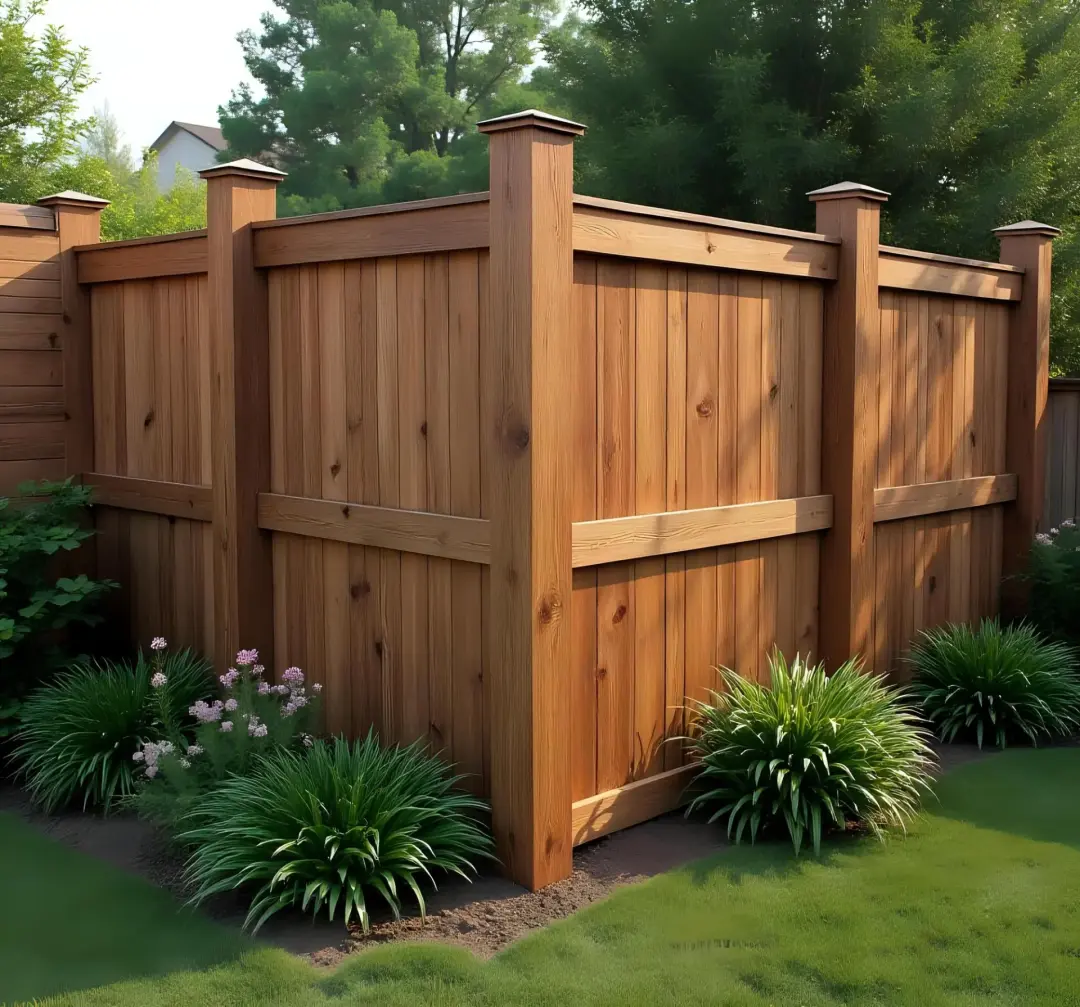
For strong visual screening at garden level, well-built closeboard or tongue-and-groove panels are usually the best starting point. Double-sided slatted panels offer a lighter appearance but a different degree of privacy. The right choice depends on the direction of overlooking, the space you want to protect and the daylight you want to retain.
Privacy Fence Panels: Identify the Sightline
Sit where you normally relax and look towards neighbouring paths, gardens and windows. Repeat the exercise standing up. A fence that screens a seated person from a nearby path may do little against an upstairs window.
In a Preston courtyard, mark the section that needs screening before deciding to enclose the entire boundary. A screen close to a patio can sometimes protect the seating area more effectively than taller perimeter fencing. Check its effect on daylight and movement around the garden. Our guide to measuring for new fence panels explains how to record the layout before ordering. The goal is useful seclusion where you spend time, rather than height for its own sake.
Closeboard for Everyday Screening
Closeboard panels use overlapping vertical boards to interrupt direct views. They suit traditional gardens and long boundaries where a consistent enclosed appearance is wanted. Look for adequate overlap, sound framing and neat connections to posts and gates.
Timber moves as its moisture content changes. Inspect the construction rather than expecting a new panel to remain completely unchanged. A large gap beside a gate can undermine the screening provided elsewhere. Check the complete run, including its lowest points, rather than choosing from a single panel sample alone.
Tongue and Groove for a Continuous Backdrop
Interlocking boards give tongue-and-groove panels a tidy surface that works well beside dining areas and patios. They are worth considering where you want fewer direct sightlines through board joints and a more finished backdrop.
Compare the board profile, frame and installation instructions. A solid face catches wind, so the posts and foundations must suit the location. Neither interlocking boards nor a decorative frame makes a panel storm-proof. For an exposed site, discuss whether a more permeable design would provide an acceptable balance between screening and airflow.
Double Slats: Check Every Viewing Angle
Staggered slats on opposite faces interrupt a straight-on view while admitting light and air. Oblique and downward views may reveal more than a product photograph suggests. These panels suit people who accept partial screening in exchange for a lighter boundary.
A current Forest Garden double-slatted panel specification lists a width of 180 cm, height of 91 cm and depth of 4.6 cm, with a 15-year anti-rot guarantee. The manufacturer describes a degree of privacy. This low-height product illustrates why a “privacy” description alone does not establish suitability for a full-height boundary. The guarantee concerns rot, subject to terms, rather than screening performance.
Recognise the Limits of Open Panels
- Single slats: gaps can leave clear views between gardens.
- Trellis: decorative support rather than an immediately opaque screen.
- Picket: defines an edge while retaining an open outlook.
- Planted screens: coverage changes with growth and season.
If year-round seclusion is essential, judge the fence without relying on future planting to fill every opening. Also separate privacy from noise control: blocking a view does not establish a tested reduction in traffic or neighbour noise. An acoustic problem needs an appropriately specified system.
Check Height and the Finished Layout
In England, Planning Portal guidance generally allows fencing up to 2 metres elsewhere and 1 metre beside a highway used by vehicles, including its footpath, without a planning application, subject to other conditions and exceptions. Listed buildings and removed permitted development rights can alter the position; ask the local planning authority where uncertain.
Assess the complete finished height, including additions. View a sample at seated height and at an angle. On sloping land, check openings beneath stepped panels. Explore our fence panels and trellis service before settling on the design.
Summary: Screen the View That Matters
Start with enclosed panels for stronger screening or double slats where some openness is acceptable, and discuss your Preston garden's sightlines with Tony Malpass.